







How Does Solar Power Work? A Simple Guide to Solar Energy

Have you ever looked at a rooftop covered in sleek, dark solar panels and wondered, “How exactly do those glass squares turn sunlight into electricity?”
While it feels like magic, solar power is actually rooted in an elegant 19th-century physics discovery known as the Photovoltaic (PV) Effect. In this simple, jargon-free guide, we will break down exactly how solar panels generate electricity, how it powers your home, and what happens when the sun goes down.
The Core Science: What is the Photovoltaic Effect?
At the heart of every solar panel is a material you can find in almost all modern electronics: Silicon.
Silicon is a semiconductor. In a solar cell, scientists sandwich two different layers of silicon together:
The Top Layer (N-type): This layer is injected with extra electrons, giving it a negative charge.
The Bottom Layer (P-type): This layer has missing electrons (called "holes"), giving it a positive charge.
When these two layers touch, they create an internal Electric Field right at the junction, acting like a microscopic battery waiting to be activated.
Because of the built-in electric field, these loose electrons are forced to move in a single, orderly direction. This movement of electrons is what we call Electricity!
Step-by-Step: The 4 Core Components of a Solar System
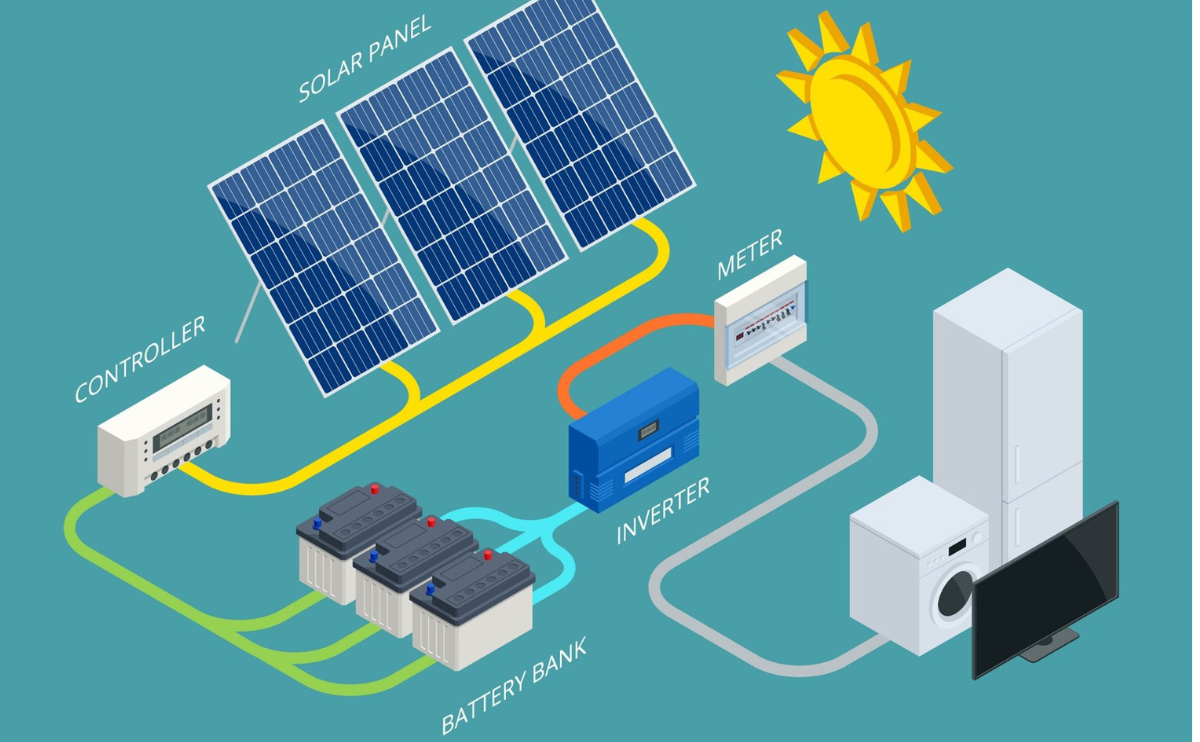
Generating electricity on your roof is only the first step. To safely turn on your TV or refrigerator, the power must travel through a 4-step ecosystem:
Step 1: Solar Panels Capture Sunlight (DC Power)
As sunlight knocks electrons loose, the solar panel collects this energy. At this stage, the electricity is generated as Direct Current (DC)—the same type of raw power stored in standard AA batteries.
Step 2: The Inverter Converts the Power (AC Power)
Your home appliances cannot use DC electricity; they run on Alternating Current (AC). This is where the Solar Inverter (the "brain" of the system) comes in. It takes the raw DC power from the panels and instantly transforms it into clean AC power.
Step 3: The Service Panel Distributes Electricity
Once converted into AC power, the electricity travels directly into your home’s breaker box (Service Panel). From here, it automatically routes power to your active appliances—running your air conditioner, charging your phone, or powering your kitchen.
Step 4: The Utility Meter Handles Excess Power (Net Metering)
What happens if your panels generate more electricity than your home is using?
Grid-Tied Systems: The excess energy flows back into the main city grid. Thanks to a policy called Net Metering, your electric meter will literally spin backward, earning you credits from your utility company.
Battery-Storage Systems: If you install a solar battery (like a Tesla Powerwall), the excess energy is routed to fill up your battery first, saving it for nighttime use.
Frequently Asked Questions About Solar Physics
Q1: Do solar panels work on cloudy or rainy days?
Yes. Solar panels do not need scorching heat; they require light. While heavy cloud cover reduces efficiency by roughly 50% to 75%, panels still harvest diffused sunlight and continue to generate power.
Q2: Do solar panels work at night?
No. Solar panels require photons from the sun to knock electrons loose. At night, your system goes to sleep, and your home seamlessly switches back to drawing power from either the grid or your home battery backup.
Q3: Ready to See What Solar Can Do For You?
Understanding how solar works is the first step toward energy independence. By replacing unpredictable grid electricity with a free, predictable resource like sunlight, you lock in low power rates for the next 25+ years.
Curious about how many panels your specific roof needs? Use our quick calculator in the right sidebar! Input your monthly electricity bill, and our engineers will create a free 3D solar layout tailored to your home.


